
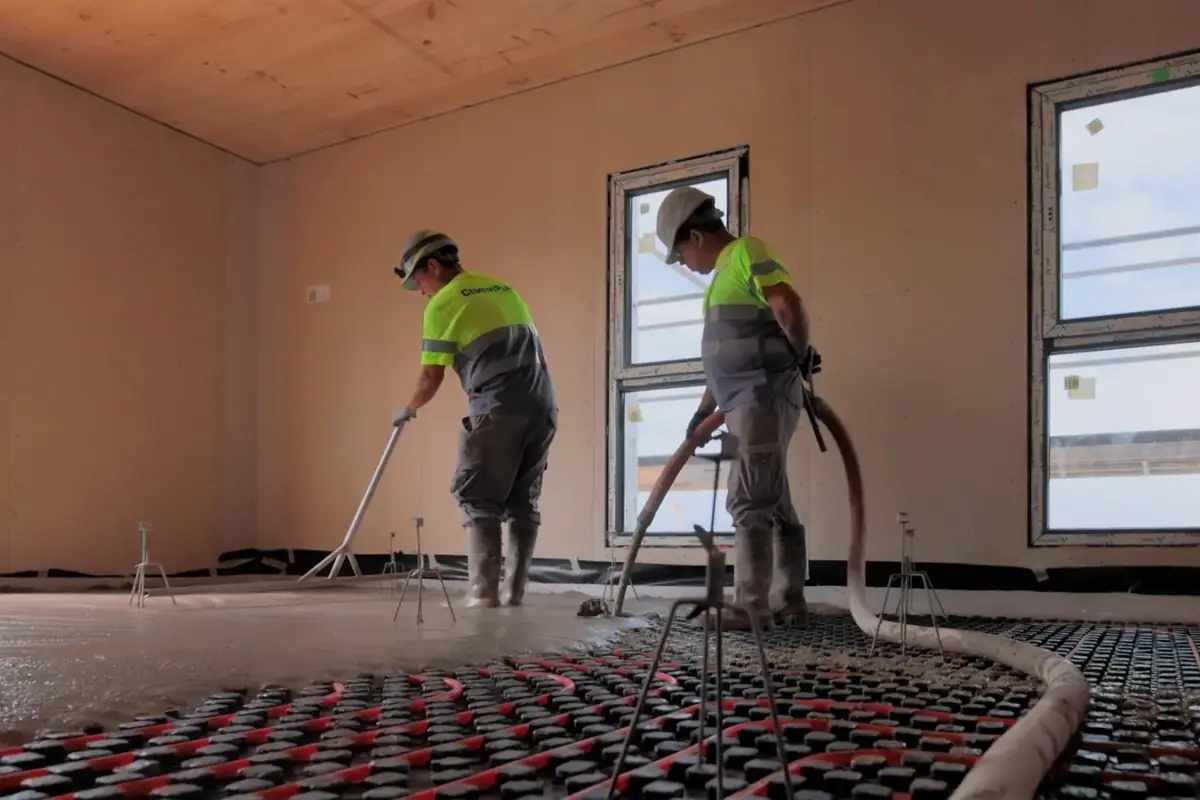
Why the screed matters in underfloor heating
In a water-based underfloor heating system, heat crosses the pipe wall, the screed and the floor finish before it reaches the room. Each layer opposes a thermal resistance equal to its thickness divided by its conductivity (R = e/λ). The better the screed conducts, the less it holds the heat back.
A more conductive screed delivers the same heat with cooler water, and the room reaches comfort temperature sooner. With a heat pump the gain is twofold: the lower the flow temperature, the better the efficiency.
What FloorGraphene changes in consumption
In the case study of a home in Madrid with a COP 3 heat pump, annual HVAC energy consumption — heating and cooling — falls by up to 30 %. Comparative studies carried out in Madrid, Alicante and the Pyrenees point to savings of 20 % to 40 %, depending on the home.
Those 30 % are a drop in consumption, not an increase in conductivity. Conductivity goes from 0.88 to 1.5–2.0 W/m·K, which is an increase of 70 % to 127 %.
The recast of the European directive on the energy performance of buildings, (EU) 2024/1275, requires new buildings to be zero-emission buildings from 2030. Underfloor heating connected to a heat pump serves both to heat in winter and to cool in summer.
Cement screed with FloorGraphene or anhydrite screed?
Self-levelling anhydrite screed (calcium sulfate) is often chosen for its conductivity: 1.55 W/m·K in our reference tests. With FloorGraphene, a cement screed reaches 1.5 W/m·K with limestone aggregate and 2.0 W/m·K with siliceous aggregate.
It remains a cement screed: it tolerates the moisture of normal use, it is prepared as usual before the floor finish and it costs less to place than anhydrite. FloorGraphene also improves compressive and flexural strength, and durability.