When you order a C25/30 concrete, you are ordering a strength above all: a characteristic compressive strength at 28 days of 25 N/mm² on cylinders, or 30 N/mm² on cubes. It is the property most closely checked on any concrete job, and the one that raises the most questions when test results fall short.
This guide explains exactly what concrete compressive strength is, how the designation is read, how it is tested, how much strength concrete should have at each age and what raises or lowers it.
What concrete strength is
When people talk about concrete strength they almost always mean compressive strength. In tension concrete resists only about a tenth of that, which is why it is reinforced: the reinforcement takes the tensile forces that the concrete cannot.
The value that governs design is the characteristic strength, fck: the 28-day compressive strength that 95 % of the concrete supplied is expected to exceed. It is not the mean of the test results but a lower value with a statistical margin. It is expressed in N/mm², which is the same as megapascals (MPa). EN 206 gives it twice, for 150 × 300 mm cylinders (fck,cyl) and for 150 mm cubes (fck,cube), because a cube of the same concrete gives a higher reading.
How to read C25/30, XC2, S3
Under EN 206, which the UK applies through BS 8500, a concrete specification states the strength class, the exposure class, the consistence class, the maximum aggregate size and the chloride class:
| Part | Example | What it means |
|---|---|---|
| Strength class | C25/30 | Characteristic compressive strength at 28 days: 25 N/mm² on cylinders / 30 N/mm² on cubes (LC for lightweight concrete) |
| Exposure class | XC2 | Environment: X0 no risk, XC carbonation, XD chlorides other than from seawater, XS seawater, XF freeze–thaw, XA chemical attack |
| Consistence class | S3 | Workability: slump classes S1–S5 or flow classes F1–F6 |
| Maximum aggregate size | Dmax 20 | In millimetres |
| Chloride class | Cl 0,40 | Maximum chloride content as a percentage of cement mass: Cl 0,40 for reinforced concrete, Cl 0,20 for prestressed |
There is no single minimum for reinforced concrete. EN 206 recommends a minimum strength class for each exposure class, together with a maximum water/cement ratio and a minimum cement content, because durability depends on them. National standards may vary those values: BS 8500 in the UK, which also ties strength to cover and intended working life, and DIN 1045-2 in Germany.
| Exposure class | Typical situation | Recommended minimum |
|---|---|---|
| X0 | Unreinforced concrete, no risk of corrosion | C12/15 |
| XC1 | Dry indoors, or permanently under water | C20/25 |
| XC2 | Wet, rarely dry: many foundations | C25/30 |
| XC3 / XC4 | Moderate humidity; cyclic wet and dry (external surfaces exposed to rain) | C30/37 |
| XD1 / XD2 / XS1 | Airborne chlorides, coastal structures, swimming pools | C30/37 |
| XD3 / XS2 / XS3 | De-icing salts on car park decks and pavements; marine structures | C35/45 |
Recommended values from an informative annex. Freeze–thaw (XF) and chemical attack (XA) classes have their own minimums.
Strength classes table
The table shows the most common EN 206 classes with both values and, for reference, the cylinder strength in psi (1 N/mm² ≈ 145 psi), the unit used in American specifications.
| Strength class | fck,cyl (cylinder) | fck,cube (cube) | ≈ psi (cylinder) | Typical use |
|---|---|---|---|---|
| C20/25 | 20 N/mm² | 25 N/mm² | ≈ 2,900 | Mass concrete and unreinforced foundations; reinforced concrete in dry interiors |
| C25/30 | 25 N/mm² | 30 N/mm² | ≈ 3,600 | Ordinary building work in non-aggressive conditions |
| C30/37 | 30 N/mm² | 37 N/mm² | ≈ 4,350 | External exposure, foundations in wet ground, civil engineering |
| C35/45 | 35 N/mm² | 45 N/mm² | ≈ 5,100 | Aggressive environments (chlorides, de-icing salts), precast |
| C40/50 – C50/60 | 40–50 N/mm² | 50–60 N/mm² | ≈ 5,800–7,250 | Precast, prestressed, high-performance concrete |
The strength required is set by the structural design and the exposure class.
How it is tested: slump, cubes and cylinders
- Sampling on site (EN 12350-1), from the concrete as it arrives in the truck mixer.
- Consistence with the slump test (EN 12350-2): it measures how far a cone of fresh concrete slumps when the mould is lifted, and checks that the concrete is what was ordered and that no water has been added. Flowing mixes are checked with the flow table test (EN 12350-5).
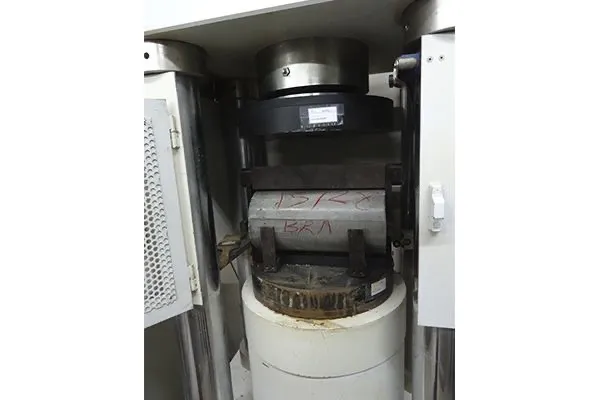
- Making specimens (EN 12390-2): in the UK usually 150 mm cubes, in much of Europe 150 × 300 mm cylinders, compacted and cured under standard conditions.
- Compression testing (EN 12390-3): in a testing machine, usually at 7 and 28 days. The statistical conformity criteria of EN 206 determine whether the concrete complies.
Strength at 7 and 28 days
Concrete gains strength quickly at first and then more and more slowly. Eurocode 2 (EN 1992-1-1, 3.1.2) estimates the development with βcc(t) = exp{s · [1 − (28/t)^½]}, where s depends on the cement class:
| Age | Cement class S (s = 0.38) | Class N (s = 0.25) | Class R (s = 0.20) | C25/30, class N: cylinder / cube |
|---|---|---|---|---|
| 3 days | ≈ 46 % | ≈ 60 % | ≈ 66 % | ≈ 15 / 18 N/mm² |
| 7 days | ≈ 68 % | ≈ 78 % | ≈ 82 % | ≈ 19.5 / 23 N/mm² |
| 28 days | 100 % | 100 % | 100 % | 25 / 30 N/mm² |
| 90 days | ≈ 118 % | ≈ 112 % | ≈ 109 % | ≈ 28 / 34 N/mm² |
Mean-strength estimates at 20 °C. Class R = CEM 42.5 R, 52.5 N and 52.5 R; class N = CEM 32.5 R and 42.5 N; class S = CEM 32.5 N. Actual development depends on the cement, temperature and curing; acceptance is based on the 28-day results.
So for a C25/30 with a class N cement, 7-day results of about 20 N/mm² or more on cylinders (23–24 N/mm² on cubes) are a good sign, but not the final proof. And because mixes are designed for a mean strength well above fck (Eurocode 2 assumes fcm = fck + 8 N/mm²), a well-designed concrete usually tests higher than these figures. Setting and hardening times are covered in how long concrete takes to cure.
What raises and lowers it
- The water/cement ratio. It matters most: the less water per kilo of cement, the higher the strength. Every litre of surplus water leaves pores behind when it evaporates.
- The cement: its type, its strength class and the content per cubic metre.
- Compaction. Air trapped by poor vibration is costly: as an order of magnitude, each 1 % of voids can cost around 5 % of strength.
- The aggregates: clean, strong and with a well-designed grading.
- Curing. Without water in the first days, the cement at the surface does not hydrate and that layer stays weak and porous.
- The temperature during hardening.
- Admixtures. They allow the water to be reduced without losing workability and, in the case of graphene-based admixtures, densify the cement matrix.
The two figures are alternatives: either strength goes up with the same cement, or strength stays the same with less cement. What suits each plant is decided through preliminary trials.
What to do if test results are low
A batch that does not reach the specified strength does not mean demolition. The engineer can ask for further investigation:
- Cores drilled from the structure and tested (EN 12504-1). This is the most reliable measure of in-situ strength, which is assessed according to EN 13791.
- Non-destructive tests, such as the rebound hammer (EN 12504-2) or ultrasonic pulse velocity (EN 12504-4), to estimate strength and its uniformity at many points.
- Checking the design with the actual strength: the element often still complies, with a margin.
With that data, the decision is made: accept the structure as it is, strengthen it or take other measures.