‘Wait for it to go off’ is one of the most common phrases on site, and one of the most misunderstood. Concrete doesn’t set because it dries: it sets because the cement reacts chemically with water. In fact, if it dries out too early, it sets and hardens worse.
This guide explains what concrete setting is, how it differs from hardening and curing, how setting time is measured, what speeds it up or slows it down and which site mistakes spoil it. If you are after actual timings, see how long concrete takes to cure.
What setting means
Setting is the change of the cement paste from a plastic to a solid state. For a few hours concrete can be transported, placed and compacted; then it begins to lose plasticity, stiffens and ends up as a solid. That transition is setting.
Four words get mixed up on site, and in English the confusion is worse because ‘cure’ is often used for all of them:
- Setting: the change from plastic to solid. It takes hours.
- Hardening: the strength gain of concrete that is already solid. It goes on for weeks and months, which is why design strength is checked at 28 days.
- Curing: something you do, not something the concrete does: keeping it moist and at a suitable temperature in the first days so that the cement can keep hydrating.
- Drying: the loss of surplus water. It is not what makes concrete set and, if it comes too soon, it does harm.
What happens inside: cement hydration
Portland cement is made mainly of clinker, a mix of calcium silicates and aluminates produced in the kiln at about 1,450 °C (we cover it in what cement clinker is). In contact with water these compounds react and form new crystals that grow, interlock and bind the mix together:
- Tricalcium silicate (C₃S) reacts over hours and days: it is responsible for setting and early strength.
- Dicalcium silicate (C₂S) reacts more slowly and provides long-term strength.
- Tricalcium aluminate (C₃A) would react almost instantly; that is why cement contains a little gypsum, which holds it back and regulates setting.
The main product is calcium silicate hydrate (C-S-H) gel, the ‘glue’ that provides strength. Calcium hydroxide forms as a by-product, often referred to as free lime; it keeps concrete alkaline and protects the steel reinforcement. The reaction also gives off heat: in large pours it has to be controlled to prevent cracking.
The stages, from fresh to hardened
| Stage | What happens | On site |
|---|---|---|
| Dormant period | Hydration proceeds slowly; the concrete stays plastic | Transport, placing, compaction and finishing |
| Initial set | It begins to lose plasticity noticeably | No more remixing, re-vibrating or adding water |
| Final set | It is a solid, but with very little strength | Protect and cure; it cannot take loads yet |
| Hardening | It gains strength over weeks | Curing in the first days; striking formwork and loading according to the strength reached |
How setting time is measured
For cement it is measured with the Vicat needle (EN 196-3): a standard needle is lowered onto a paste of cement and water, and the time is recorded when it no longer penetrates to a given depth. EN 197-1 sets a minimum initial setting time for each cement strength class:
| Strength class | Minimum initial setting time |
|---|---|
| 32.5 | 75 minutes |
| 42.5 | 60 minutes |
| 52.5 | 45 minutes |
These are minimums for cement paste, not setting times for concrete: real concrete, with its aggregates, water and admixtures, takes considerably longer.
For concrete and mortar, penetration resistance tests are used: they measure the force needed to push a needle into mortar sieved from the concrete. On site, the practical guide is the imprint: once a finger or a boot no longer leaves a mark, the concrete has set, even though it has no real strength yet.
What speeds it up and what slows it down
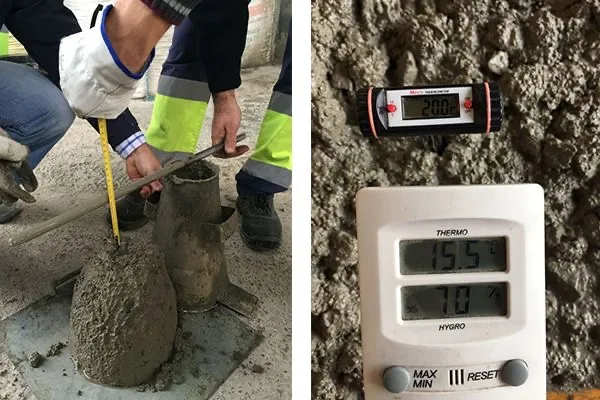
| Factor | Speeds it up | Slows it down |
|---|---|---|
| Temperature | Warmth | Cold; below about 5 °C it almost stops |
| Cement | Class R (high early strength), finer grinding | Cements with a high content of additions (slag, fly ash, pozzolana) |
| Water | Less water per kilo of cement | Excess water |
| Admixtures | Set and hardening accelerators | Retarders; some superplasticisers at high dosages |
| Contamination | — | Organic matter, sugars, certain salts |
| Weather | Direct sun (and wind dries and cracks the surface) | Cold weather and frost |
Admixtures are the tool for matching setting to each job. We explain them in the guide to types of concrete admixtures.
False set and flash set
Two anomalies that are often confused:
- False set. The concrete stiffens a few minutes after mixing, but if it is remixed without adding water it regains its workability and sets normally. It is usually caused by gypsum in the cement having dehydrated because of excessive temperature during grinding.
- Flash set. The aluminate reacts all at once because there is not enough regulator, with a lot of heat and a stiffness that does not come back. It is irreversible and the concrete cannot be used.
Site mistakes that spoil setting
- Adding water to ‘bring back’ concrete that has started to set. It raises the water/cement ratio and lowers strength and durability.
- Vibrating or remixing after initial set. It breaks up the crystals that are forming.
- Not curing. If the surface loses its water in the first hours, the cement does not hydrate, plastic shrinkage cracks appear and the surface layer is left weak.
- Pouring in freezing weather without protection. Concrete must not freeze before it has reached a compressive strength of about 5 N/mm²; if the water freezes earlier, the damage is permanent.
- Stopping the pour for too long. The previous layer starts to set and a cold joint forms: a weak, permeable plane.
Graphene in hydration
In the SmartADDITIVES range, graphene acts in precisely this phase: it reacts with the free lime that forms during hydration, bonds chemically to the cement structure and densifies the matrix. The result is more strength with less water, which makes it possible to reduce the cement content while keeping the same performance.