
“Conductive concrete” is used for two different things: concrete that conducts electricity, and concrete or screed that conducts heat better. Both are achieved with similar materials, mostly carbon-based, but they serve very different purposes and are at very different stages of maturity.
Two meanings: electricity or heat
| Electrically conductive | Thermally conductive | |
|---|---|---|
| Aim | Current passes through the concrete | Heat passes through the material faster |
| How it is achieved | Exceeding the percolation threshold with conductive fibres or particles | Additives and aggregates that raise the thermal conductivity of the matrix |
| Uses | Earthing, de-icing, shielding, self-sensing | Underfloor heating, radiant surfaces, ground-source heat exchange |
| Maturity | Extensive research and pilot projects | Commercial use in underfloor heating |
Electrically conductive concrete
Ordinary concrete conducts little electricity, and what it does conduct depends on moisture: the current travels through the water in the pores. Dry, it is a poor conductor; wet, slightly better, but its resistivity remains high and highly variable.
To make it conductive, a material that does conduct is added: carbon fibres, carbon black, graphite, steel fibres or shavings, carbon nanotubes or graphene. In small amounts nothing happens; above a certain dosage, known as the percolation threshold, the particles start to touch or sit very close together, form continuous paths, and resistivity drops sharply. The challenge is to get there with a reasonable dosage, well dispersed and stable over time.
What it is used for
- Earthing and lightning protection: conductive concrete improves electrical contact with the ground.
- De-icing pavements: when a current is passed through it, the concrete itself warms up by the Joule effect and melts snow and ice on ramps, bridge decks or runways.
- Electromagnetic shielding of rooms housing sensitive equipment.
- Self-sensing concrete: its resistivity changes when it deforms or cracks, so the structure itself can act as a sensor for monitoring its condition.
- Cathodic protection anodes, in the form of conductive mortars applied to structures that need protecting against corrosion.
Thermally conductive concrete and screed
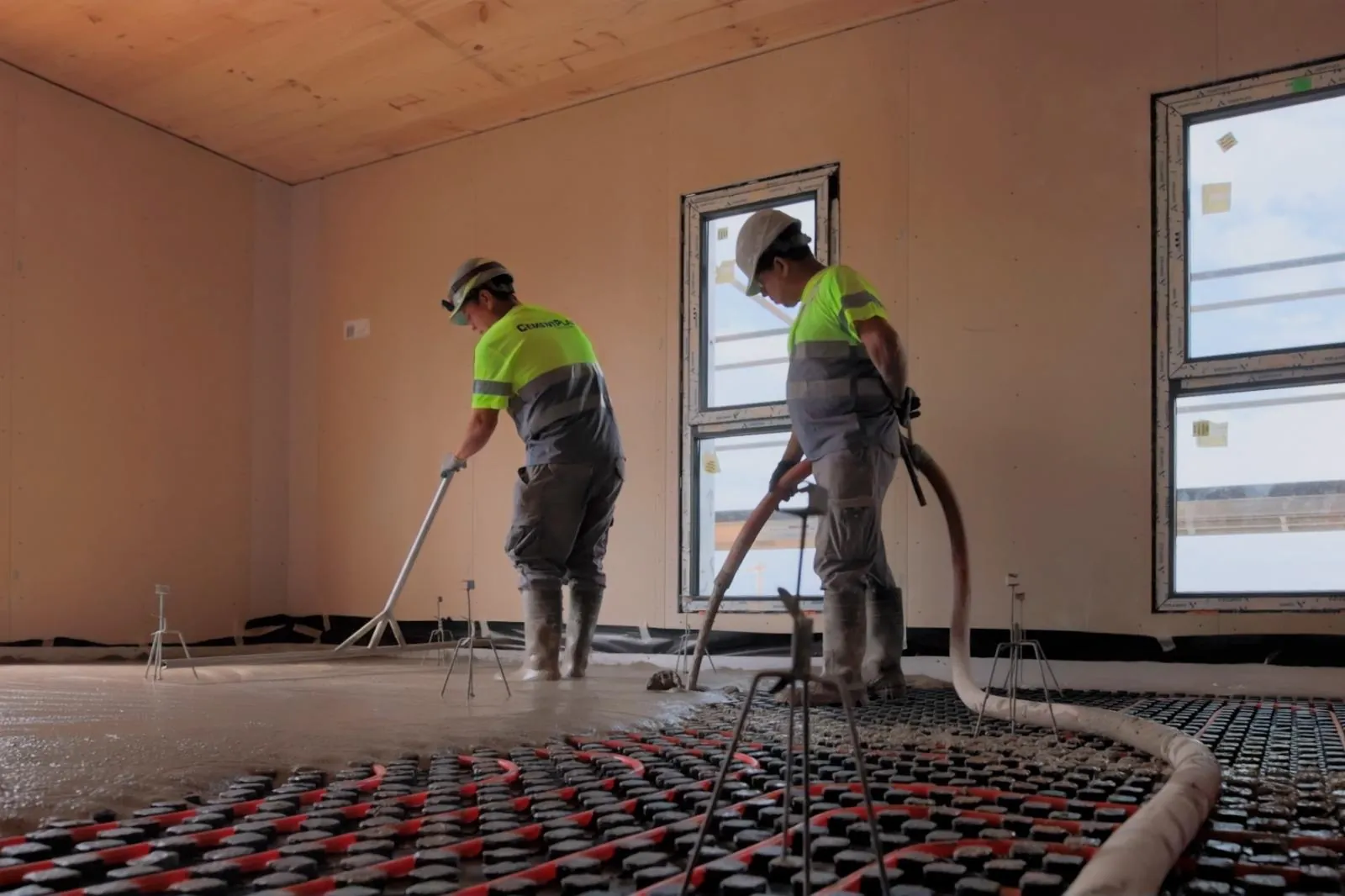
Here the aim is different: heat should pass through the material with less resistance. The clearest case is underfloor heating, where the screed covering the pipes has to carry heat from the water up to the floor finish. The higher its conductivity, the sooner the heat arrives and the lower the temperature the system can run at.
Values from our reference tests.
That is what FloorGraphene does: a liquid additive dosed into the screed at the batching plant or into the truck mixer on site, at 1.5 kg/m³. It does not turn the floor into electric heating: the installation is still the usual water-based system, but the screed conducts heat better. The details are in our guide to screed for underfloor heating.
Along the same lines, Graphenano has developed with Taiba Gold 11 mm graphene panels with high thermal transmittance for a radiant heating and cooling system in homes in Dubai’s desert climate. They also contain phase-change materials that store and release energy through the day.
What graphene adds
- Conductivity: it is one of the best conductors of heat and electricity known.
- Huge specific surface area: it is a two-dimensional material only a few atoms thick, so a small amount reaches a large volume of matrix.
- Interaction with cement: in concrete admixtures, graphene takes part in hydration and densifies the matrix, which improves strength and durability.
The difficulty lies in dispersion: if graphene agglomerates, it loses almost all its advantages. Graphenano manufactures its graphene in-house in Yecla, using its own process, and supplies it already incorporated in its additives, ready for the mix.