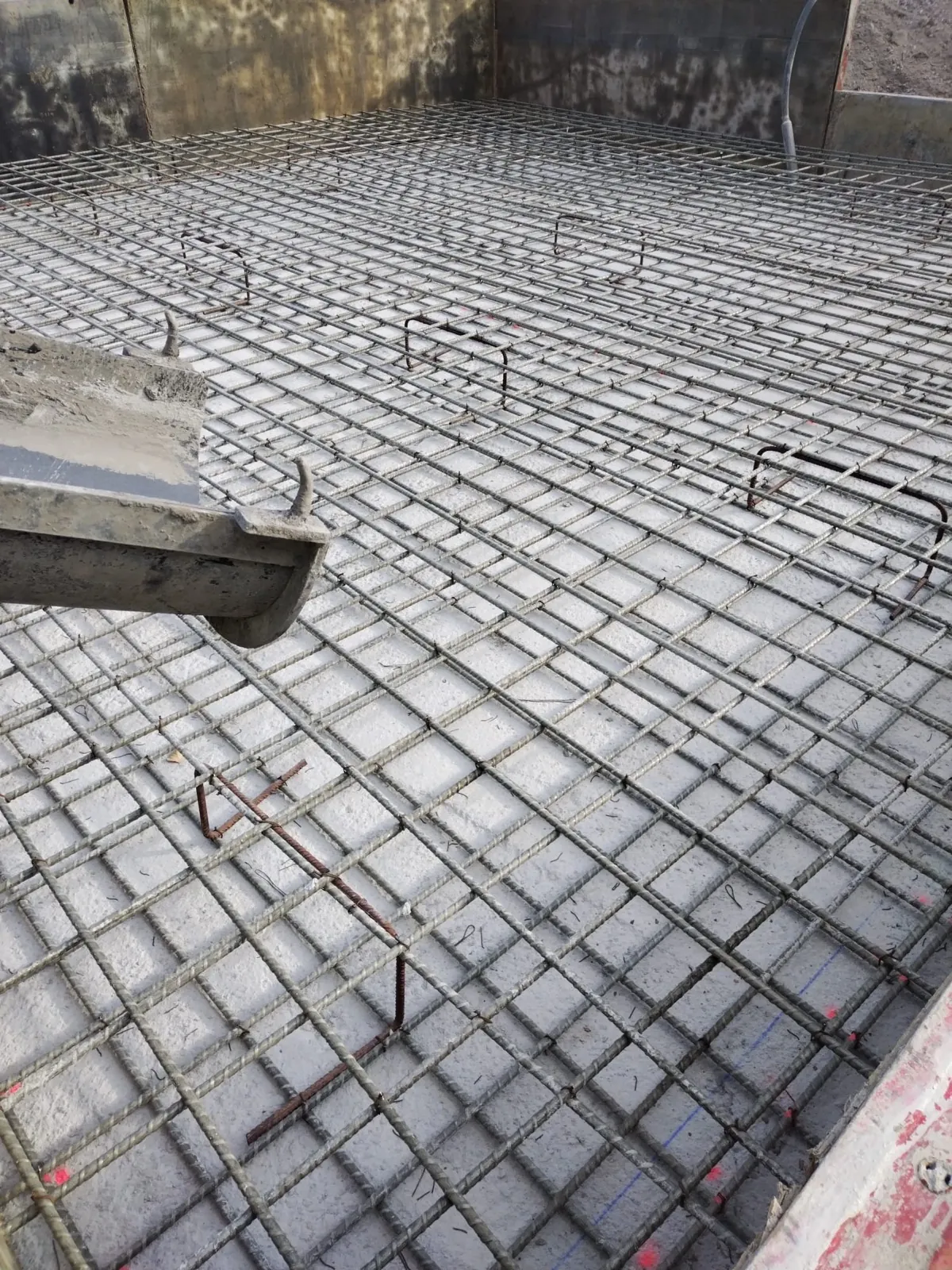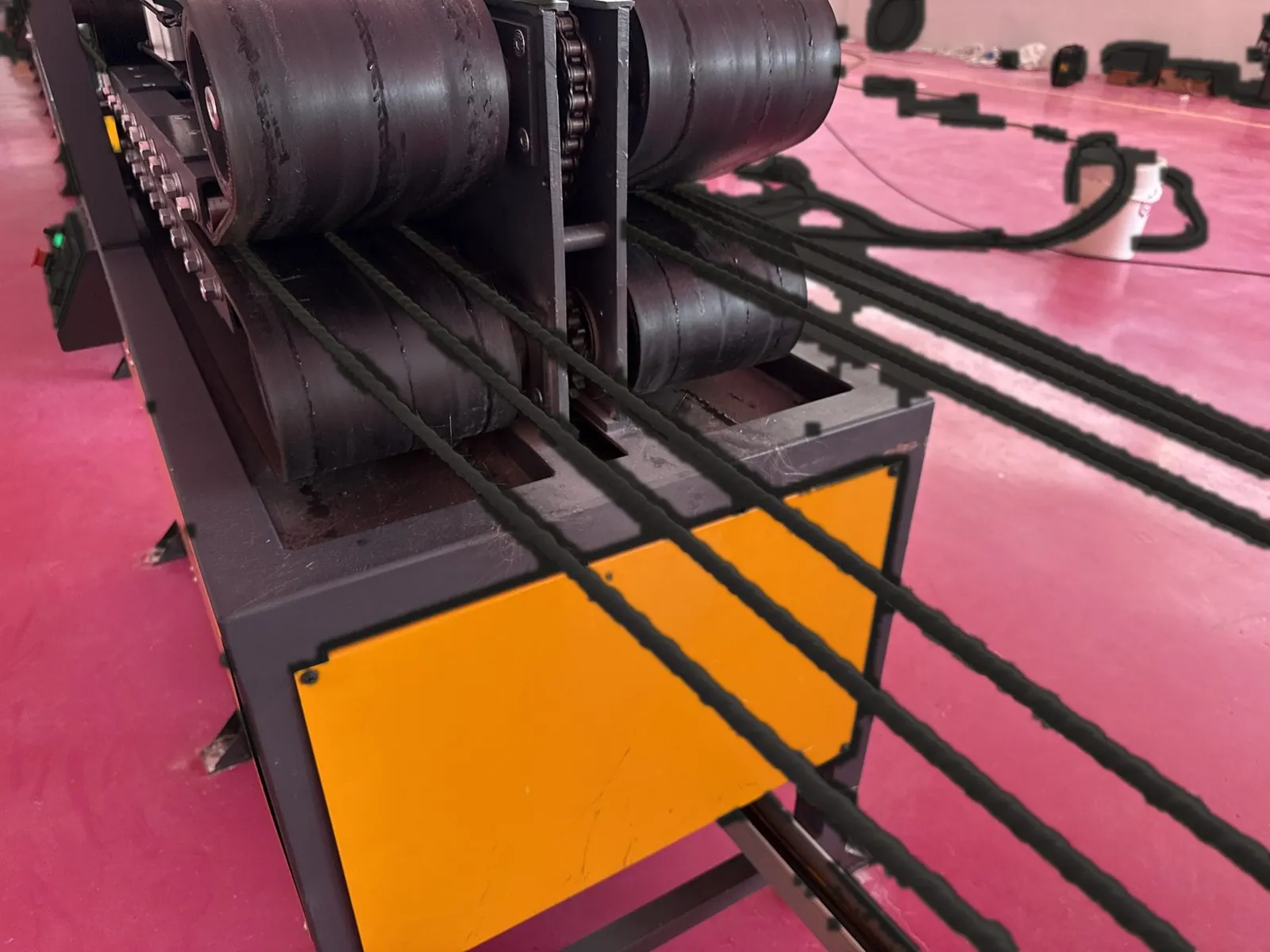
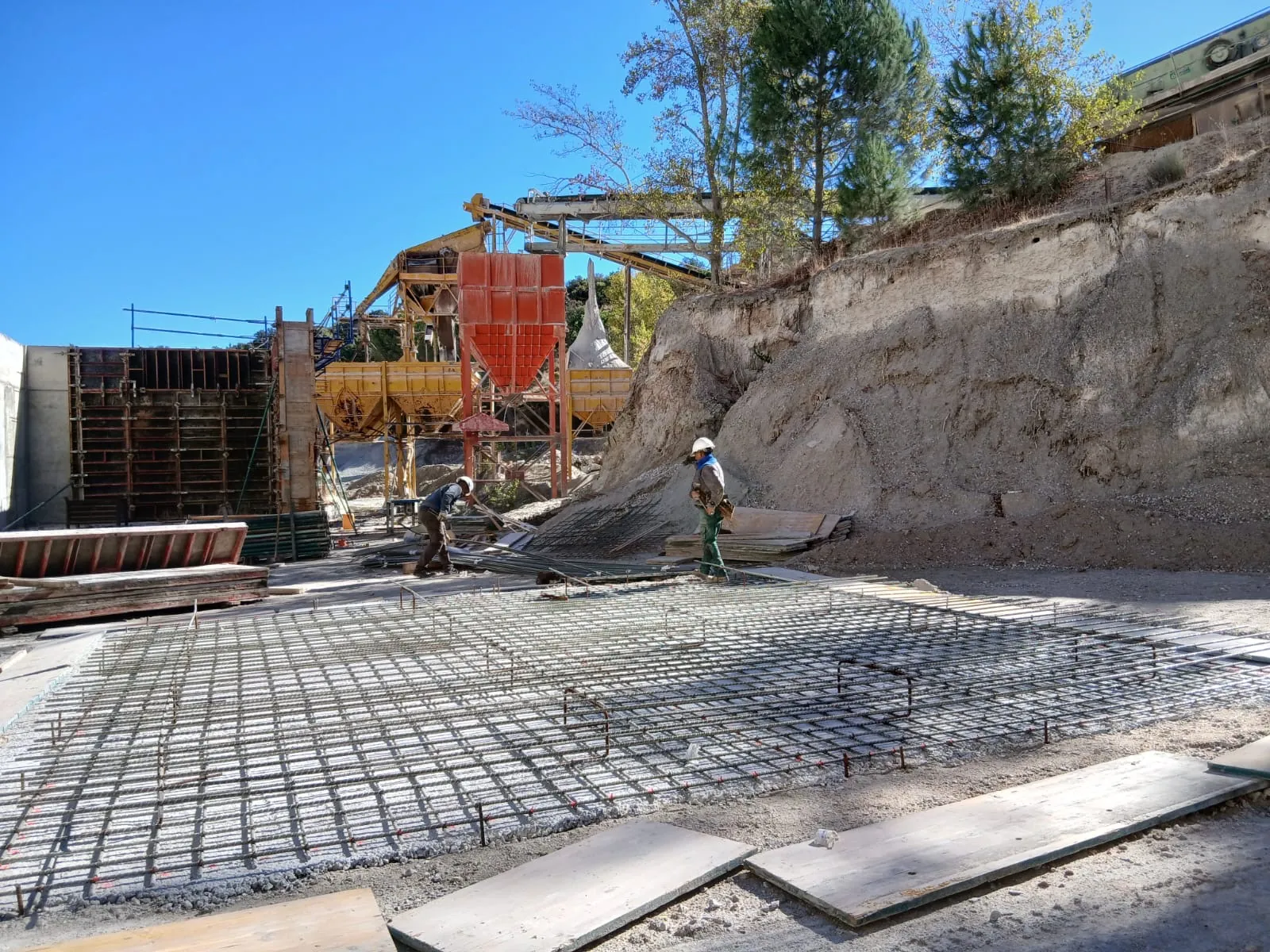
GFRP rebar (glass fibre reinforced polymer), also sold as fibreglass rebar, has been used for more than twenty years in bridge decks and marine works in Canada and the United States, and it is now turning up on ordinary sites in Europe. It does not replace steel everywhere: it weighs a quarter as much, does not rust and has a higher tensile strength, but it is far less stiff and cannot be bent on site.
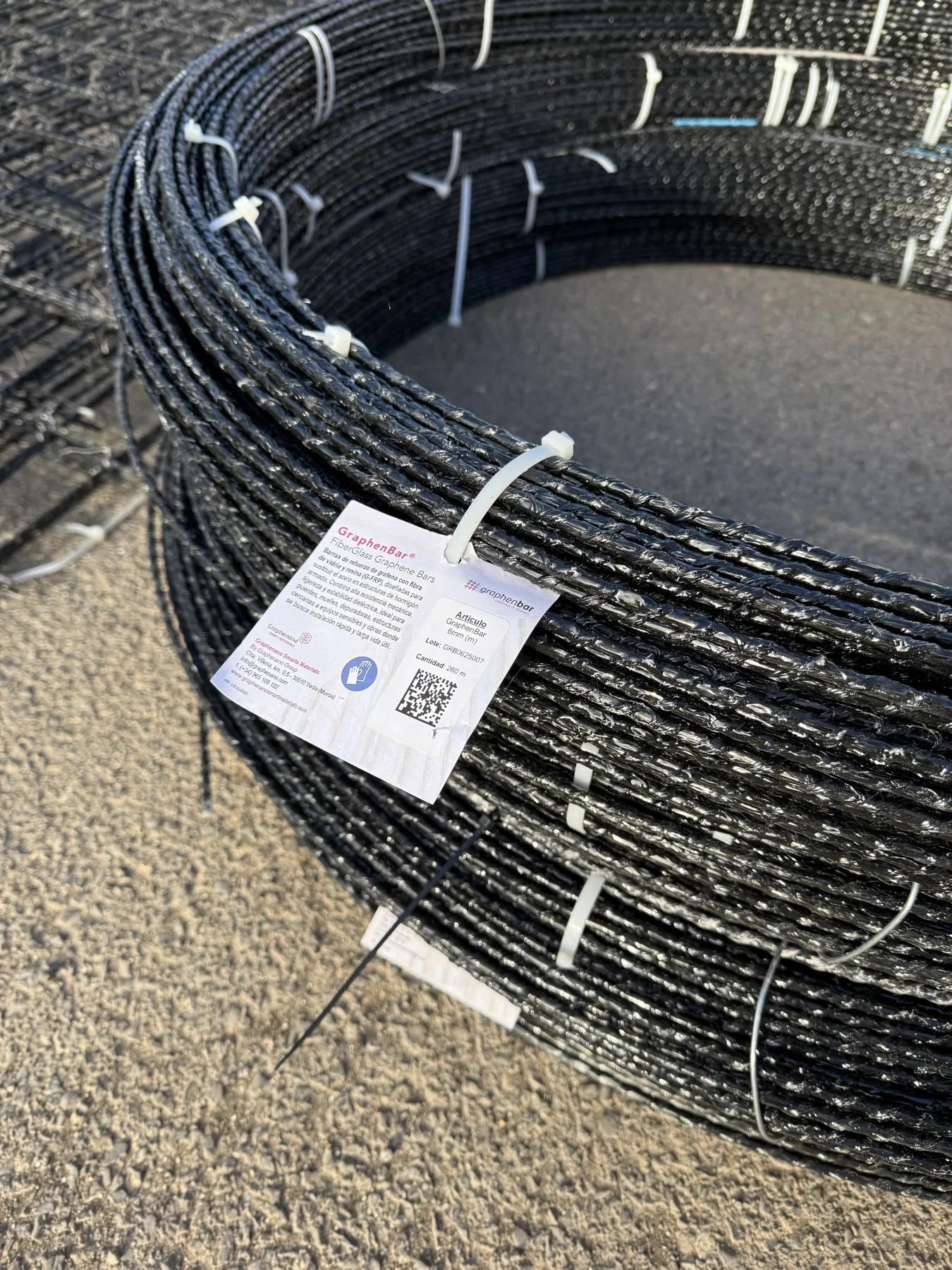
This guide sets out the differences that matter to the designer and the contractor, using data for our GraphenBar® bar, made by pultrusion in Yecla (Murcia, Spain).
What GFRP rebar is
It is a composite bar: thousands of continuous glass filaments, aligned along the length of the bar and bound together by a thermosetting resin. It is made by pultrusion, which means pulling the impregnated fibres through a heated die where the resin cures. The surface has ribs or a coating that provides bond with the concrete, the same job the ribs do on steel rebar.
Several names are used for the same thing: GFRP rebar, fibreglass rebar, glass fibre reinforcement or composite rebar. Do not confuse it with the smooth fibreglass rods sold as plant stakes, kite spars or polytunnel hoops: they have no ribs and no bond data, and they are not suitable for reinforcing concrete.
In GraphenBar the matrix is an epoxy resin with graphene manufactured in-house. The graphene improves cohesion between fibre and resin; the bar’s declared mean interlaminar shear strength is 49 to 55 MPa.
GFRP rebar vs B500 steel: the table
These are the properties that change the design and the work on site. GFRP values are those declared for GraphenBar; steel values are the usual ones for B500B and B500C rebar to BS 4449.
| Property | GraphenBar (GFRP) | B500 steel |
|---|---|---|
| Density | 1.90–1.96 g/cm³ | 7.85 g/cm³ |
| Mass of a Ø12 bar | 0.237 kg/m | 0.888 kg/m |
| Tensile strength | 773–935 MPa (characteristic, by diameter) | 500 MPa yield strength |
| Behaviour | Linear elastic up to failure | Yields before failure (ductile) |
| Modulus of elasticity | 39.5–43.7 GPa | 200 GPa |
| Ultimate strain | 1.8–2.2 % | ≥ 5 % (B500B) and ≥ 7.5 % (B500C) at maximum force |
| Corrosion | Does not corrode | Corrodes with chlorides and carbonation |
| Electricity and magnetism | Non-conductive, non-magnetic | Conductive and magnetic |
| Temperature | Tg 109.1 °C; service up to 70.5–86.9 °C | Withstands much higher temperatures |
| Bending on site | No (ordered pre-bent from the factory) | Yes |
| Cutting | Fine-tooth saw, angle grinder or diamond disc | Angle grinder or bar cutter |
GraphenBar values declared to EAD 260023-00-0301. Tg: glass transition temperature, measured on a Ø12 bar.
Two rows explain almost everything else. Strength: for the same cross-section, the fibreglass bar carries more tension than steel. And modulus: under the same load it stretches about five times as much, so the member deflects and cracks more unless it is designed for it.
Where GFRP rebar wins
It does not rust
The most common cause of deterioration in reinforced concrete is corrosion of the reinforcement: the steel rusts, expands and bursts the cover. With a non-metallic bar that mechanism disappears. That is why it makes sense in new build wherever moisture is a given: foundations and ground-bearing slabs, retaining walls, basements, swimming pools, tanks and wastewater treatment plants, as well as marine environments and structures exposed to de-icing salts. GraphenBar’s technical assessment assumes a working life of 100 years.
A quarter of the weight
In housing refurbishment, weight is what decides. Strengthening a floor or casting a new slab on an old structure with reinforcement that weighs 70 % less means less dead load, less crane time and material that can be carried up the stairs by hand. In new build the difference shows in the logistics: one lorry of GraphenBar carries as many metres of reinforcement as six lorries of equivalent steel, and handling and cutting, with no sparks, are quicker.
More tension per kilo
With a characteristic tensile strength of 773 to 935 MPa, the fibreglass bar works with smaller diameters than steel for the same tensile load. That is the basis of the indicative equivalents further down.
Transparent to electromagnetic fields
Because it is neither conductive nor magnetic, it does not interfere with sensitive equipment: MRI suites, laboratories, substations or data centres.
What it does not do like steel
An honest guide has to cover this too, because it shapes the design:
- It is less stiff. With a modulus of about 40 GPa, slabs and beams are usually governed by the serviceability limit state (deflection and crack width), not by strength. If the member was designed in steel for strength, it can be switched to high-modulus GraphenBar; if deflection governed, it is better to redesign with GFRP properties.
- It fails without warning. There is no yield plateau. Design codes compensate with higher safety factors and by aiming for the concrete in compression to fail before the bar does.
- It cannot be bent on site. Hooks, links and special shapes are made pre-bent at the factory. The bar schedule has to be finalised before ordering.
- It does not count in compression. Design guides ignore the contribution of GFRP bars in compression, which mainly affects columns.
- Temperature. The bar’s glass transition temperature is 109.1 °C and its maximum service temperature ranges from 70.5 to 86.9 °C depending on diameter. Reaction to fire is not an assessed characteristic: where fire governs the design, the engineer has to justify it.
- Seismic. Seismic behaviour is not an assessed characteristic either; use in seismic zones has to be justified by the engineer.
Standards and design in the UK and Ireland
The current Eurocode 2 (EN 1992-1-1), applied in the UK and Ireland through their National Annexes, covers concrete reinforced with steel and does not yet include FRP reinforcement. In the meantime, the engineer justifies the solution with internationally recognised documents:
- ACI CODE-440.11-22, the American Concrete Institute code for concrete reinforced with GFRP bars, and its companion guide ACI 440.1R.
- Annex R of EN 1992-1-1:2023, the second generation of Eurocode 2. It is informative and covers glass and carbon FRP reinforcement in normal-weight concrete.
- CSA S806, the Canadian standard, backed by long experience on bridges.
For the product, the European reference is EAD 260023-00-0301, the assessment document for FRP bars used to reinforce concrete. GraphenBar data are declared to that EAD and the bar is manufactured under factory production control. CE marking is in progress: the European Technical Assessment (ETA) is being processed under Regulation (EU) 305/2011 and, until it is issued, no performance is declared under that Regulation.
Indicative equivalents by diameter
As a starting point, a GraphenBar bar replaces a steel bar one commercial diameter larger. The table compares the characteristic tensile load of each diameter with the mass of the equivalent steel bar:
| GraphenBar | Char. tensile load | GraphenBar mass | Equivalent steel | Steel mass |
|---|---|---|---|---|
| Ø6 mm | 27.3 kN | 0.058 kg/m | Ø8 mm | 0.395 kg/m |
| Ø8 mm | 48.8 kN | 0.102 kg/m | Ø10 mm | 0.617 kg/m |
| Ø10 mm | 74.3 kN | 0.167 kg/m | Ø12 mm | 0.888 kg/m |
| Ø12 mm | 102 kN | 0.237 kg/m | Ø14 mm | 1.208 kg/m |
| Ø16 mm | 176.8 kN | 0.424 kg/m | Ø18 mm | 1.998 kg/m |
| Ø20 mm | 252.6 kN | 0.625 kg/m | Ø22 mm | 2.984 kg/m |
Indicative equivalence, not a design value: the engineer checks it for each member, especially where deflection or cracking governs. Mesh: a GraphenBar panel is equivalent to steel mesh one diameter up.
Price per metre
Comparing GFRP rebar on price per kilo is misleading because it weighs so little: the useful unit is the linear metre. These are the prices in our online shop, excluding VAT:
| Diameter | €/m | Formats |
|---|---|---|
| Ø6 mm | 0.37 | Packs of 25 bars, 4 or 6 m · 250 m coil |
| Ø8 mm | 0.60 | Packs of 25 bars, 4 or 6 m · 250 m coil |
| Ø10 mm | 0.91 | Packs of 25 bars, 4 or 6 m |
| Ø12 mm | 1.35 | Packs of 25 bars, 4 or 6 m |
| Ø16 mm | 2.55 | Packs of 25 bars, 4 or 6 m |
| Ø20 mm | 4.68 | Packs of 25 bars, 4 or 6 m |
Ø14 and Ø18 are also available, as is 6 × 2.2 m mesh from €17.19 per panel. Shop prices as of October 2026.
To compare with steel, look at the cost of the whole job: transport, crane and handling hours, the coatings or inhibitors used to protect steel from corrosion, and maintenance over the working life.
Installation on site
- Cutting: with a fine-tooth saw, angle grinder or diamond disc. The ends do not need sealing. Wear a dust mask.
- Tying: as with steel, making sure the bar is firmly fixed to the spacers. It is light and, if left loose, it can shift during pouring and vibration.
- Cover and layout: set by the engineer according to the design for each project.
- Storage: on bearers, off the ground, and protected from sunlight if it is to be stored for a long time.