Reinforced concrete works because it shares out the load: the concrete takes compression and the steel takes tension. Its weak point is that steel rusts. Rebar corrosion is the leading cause of deterioration in concrete structures: bridges, car parks, tanks, buildings on the coast.
This guide explains why steel corrodes when concrete is meant to protect it, what the symptoms are, how corrosion of rebar in concrete is diagnosed and repaired and, above all, how to prevent it at design stage.
Why steel corrodes when concrete protects it
Concrete is highly alkaline: the water in its pores has a pH above 12.5, thanks to the lime formed as the cement hydrates. In that environment a very thin film of stable oxide forms on the steel, the passive layer, and protects it. As long as that layer is intact, the reinforcement does not corrode.
That protection is lost in two ways:
- Carbonation: CO₂ from the air lowers the pH of the concrete down to the depth of the reinforcement.
- Chlorides: they reach the steel and break down the passive layer even though the pH stays high.
Once the passive layer has gone, corrosion needs water and oxygen to progress. That is why concrete that is always submerged or always dry corrodes very slowly, while concrete that is repeatedly wetted and dried corrodes quickly.
Carbonation
CO₂ from the air enters the concrete through its pores and reacts with the lime, turning it into calcium carbonate. The pH drops from above 12.5 to below 9 and the passive layer is no longer stable. The carbonation front moves inwards from the surface, ever more slowly: roughly speaking, its depth grows with the square root of time.
It advances faster when:
- the concrete is porous: too much mixing water, too little cement, poor curing;
- relative humidity is moderate, because CO₂ barely enters saturated concrete and barely reacts in very dry concrete;
- the cover is thin or cracked.
It is detected with a very simple test, standardised in EN 14630: phenolphthalein is sprayed onto a freshly broken surface. Sound concrete turns pink; the carbonated zone stays colourless.
Chlorides
Chlorides are more dangerous because they attack locally: they break the passive layer at specific points and cause pitting that reduces the bar’s cross-section with little warning. They come from several sources:
- the marine environment, through splash, salt spray or immersion;
- de-icing salts on bridge decks, ramps and car parks;
- the concrete’s own constituents, if the aggregates, the water or an admixture contain them. That is why EN 206 sets chloride content classes: Cl 0,40 for reinforced concrete (a maximum of 0.40 % chloride by mass of cement) and Cl 0,20 for prestressed concrete.
Symptoms
Rust takes up between two and six times the volume of the steel it comes from. As it grows inside the concrete, it pushes on the cover until it cracks. The symptoms appear in this order:
- Rust staining on the surface.
- Cracks that follow the line of the bars, at column corners and on the soffits of beams and slabs.
- Spalling: the cover breaks away and the reinforcement is exposed.
- Loss of bar section and, with it, loss of load-bearing capacity.
How it is diagnosed
| Test | What it measures |
|---|---|
| Visual inspection | Staining, cracks, spalling, exposed reinforcement |
| Phenolphthalein | Carbonation depth compared with the cover |
| Chloride content | Chlorides at different depths, from drilled dust or cores |
| Covermeter | Actual cover and position of the bars |
| Half-cell potential | Probability of active corrosion over large areas |
| Electrical resistivity | How easily the concrete lets corrosion progress |
| Exploratory breakouts | Actual condition of the steel and loss of section |
How it is repaired
The repair is specified by an engineer after the diagnosis, and its principles are set out in the EN 1504 series. The usual sequence:
- Break out the damaged or contaminated concrete to behind the reinforcement.
- Clean the steel and, where it has lost section, add or replace bars.
- Protect the steel and reinstate the section with structural repair mortar, class R3 or R4 to EN 1504-3 (we cover them in types of mortar).
- Protect the surface to slow the ingress of water, CO₂ and chlorides.
There are also electrochemical techniques, such as realkalisation, chloride extraction and cathodic protection, for large or heavily contaminated structures. They all have one thing in common: they are expensive, and almost always more expensive than avoiding the problem in the first place.
How to prevent it at design stage
| Strategy | How it works | When it makes sense |
|---|---|---|
| Adequate cover | Lengthens the path for CO₂ and chlorides | Always, according to the exposure class (in the UK, BS 8500 sets cover and concrete quality) |
| Low water/cement ratio and good curing | Less porous concrete | Always |
| Suitable cement | Some additions, such as GGBS or fly ash, slow chloride ingress | Marine and chloride environments |
| Corrosion inhibitors | Delay the onset of corrosion | Aggressive environments |
| Galvanised, epoxy-coated or stainless steel | Protect or replace carbon steel | Critical or highly exposed elements |
| Cathodic protection | Keeps the steel in a range where it does not corrode | Large structures; requires maintenance |
| GFRP reinforcement | Removes the problem: the bar is non-metallic | Damp, marine or salt-exposed environments, or in contact with the ground |
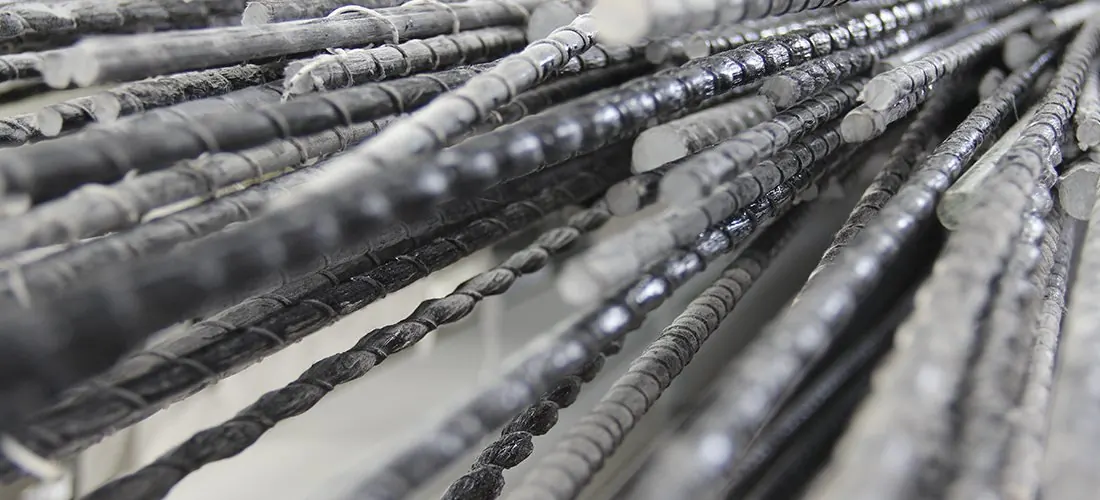
The last row is the only one that does not delay corrosion but eliminates it. A fibreglass bar has no passive layer to lose, because it does not rust. It has other properties the design must take into account, such as its lower stiffness; we explain them in GFRP rebar vs steel.
If the reinforcement has to stay in steel, the SmartADDITIVES Solid HARD range is designed for extreme exposure: durability, shrinkage-reducing and corrosion-inhibiting admixtures that improve impermeability and protection against chlorides and carbonation.