On site, “mortar” covers almost everything: laying blockwork, rendering a facade, screeding a floor, fixing tiles or repairing a column. They are very different products, each with its own standard and codes, and choosing the wrong one is expensive.
This guide sorts the types of mortar by binder and by use, explains the codes printed on the bag, including the UK mix designations, and gives a few rules for getting it right.
What mortar is
Mortar is a mix of a binder (cement, lime, gypsum, anhydrite or resin), fine aggregate (sand up to 4 mm) and water, to which admixtures and additions can be added. Unlike concrete, it contains no coarse aggregate, which is why it is applied in thin layers and is not used for structural elements of any real thickness.
It can be mixed on site, batched by volume, or come from a factory: dry factory-made mortars arrive in bags or silos, need only water and come with declared performance. Ready-to-use retarded mortars, delivered wet in tubs, are also common in the UK.
Types of mortar by binder
| Mortar | Advantages | Limitations | Typical uses |
|---|---|---|---|
| Cement | Strength, speed, durability | Stiff, more shrinkage, not very breathable | Masonry, renders, screeds, tile bedding |
| Lime (air lime or hydraulic lime) | Flexible, breathable, compatible with old masonry | Slower and weaker | Repair and conservation, breathable renders |
| Cement-lime | A balance between strength and workability | The proportions must be right | Everyday masonry and renders |
| Gypsum | Fast and easy to finish | Does not tolerate moisture | Internal plastering |
| Anhydrite (calcium sulphate) | Self-levelling, low shrinkage, thin sections | Moisture-sensitive, needs sanding and long drying | Internal screeds and underfloor heating |
| Resin (epoxy, polyurethane) | Very high chemical and mechanical resistance | Cost, more demanding application | Industrial floors, repairs, anchoring |
Types of lime mortar
Lime mortars are a family of their own, and in the UK they are the standard choice for repairing traditionally built, solid-wall buildings:
- Non-hydraulic (air) lime: lime putty or hydrated lime (CL 90 under EN 459-1). It hardens slowly by carbonation, taking CO₂ from the air, and gives the softest and most breathable mortar.
- Natural hydraulic lime (NHL 2, NHL 3.5, NHL 5): it also sets by reaction with water. The number is the strength class, the minimum compressive strength in N/mm² at 28 days; the higher it is, the stronger and less flexible the mortar.
- Hot-mixed lime mortar: quicklime slaked together with the sand during mixing, a traditional method now widely used again in conservation work.
Types of mortar by use, with their standards
Masonry (bricklaying)
For laying brick, block or stone. EN 998-2 classifies masonry mortars by compressive strength: the letter M followed by the strength in N/mm². In the UK the classes you will meet are M2, M4, M6 and M12, which replaced the old designations (iv) to (i). The standard also distinguishes general-purpose mortar (G), thin-layer mortar (T), used for thin-joint blockwork, and lightweight mortar (L).
| Class | Old designation | Cement : lime : sand | Cement : sand with plasticiser |
|---|---|---|---|
| M12 | (i) | 1 : 0–¼ : 3 | — |
| M6 | (ii) | 1 : ½ : 4–4½ | 1 : 3–4 |
| M4 | (iii) | 1 : 1 : 5–6 | 1 : 5–6 |
| M2 | (iv) | 1 : 2 : 8–9 | 1 : 7–8 |
Proportions by volume for site-mixed (prescribed) mortars, as set out in UK guidance. The stronger classes are for more exposed or more heavily loaded masonry; M4 is the usual choice for general house building.
Render and plaster
For coating walls, outside and in. EN 998-1 distinguishes general-purpose (GP), lightweight (LW), coloured (CR), one-coat (OC), renovation mortar for damp, salt-laden walls (R) and thermal insulating mortar (T). On facades, what matters is that the render keeps out driving rain and lets water vapour escape. In the UK, BS EN 13914-1 covers the design and application of external render.
Screeds
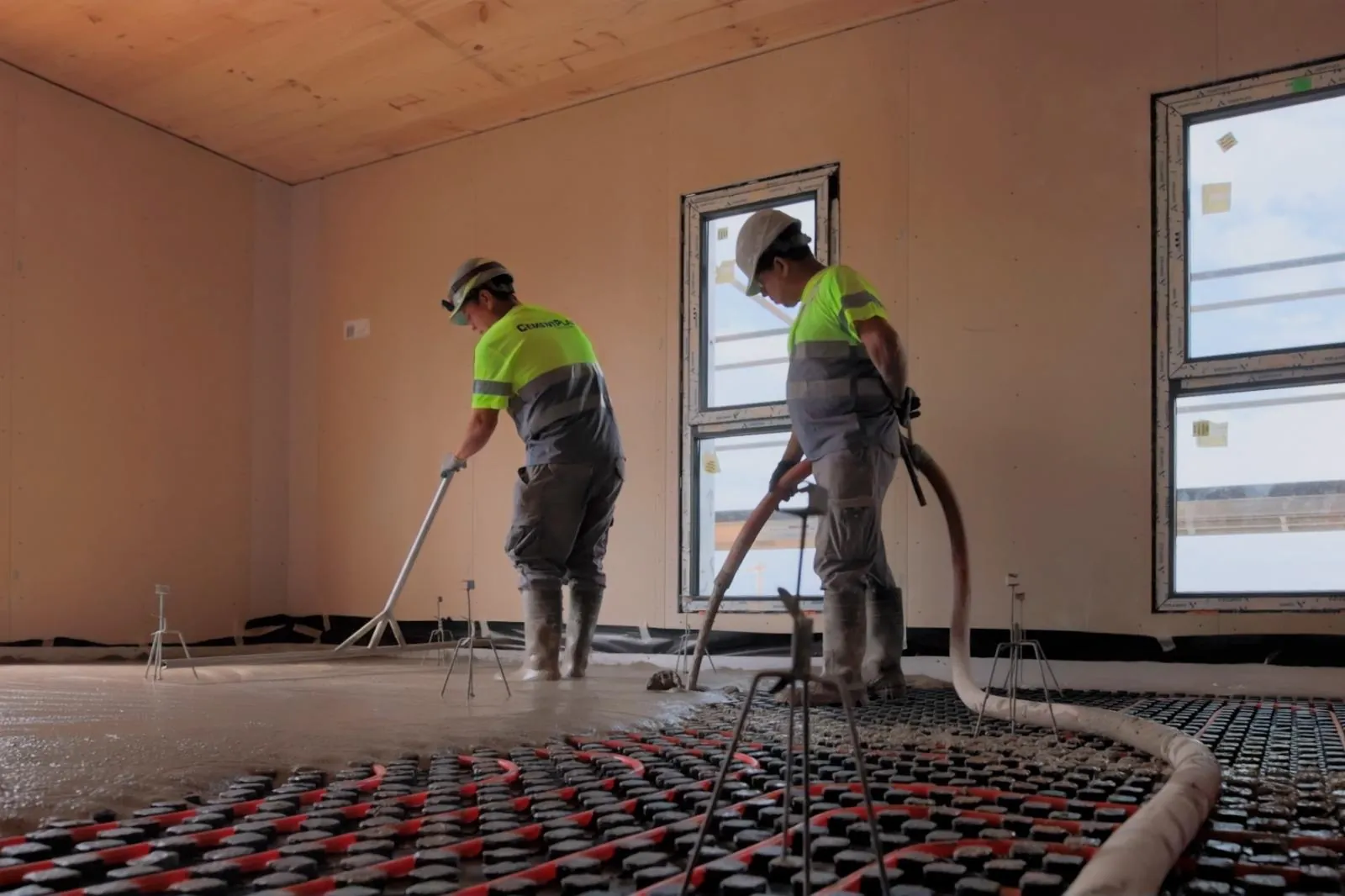
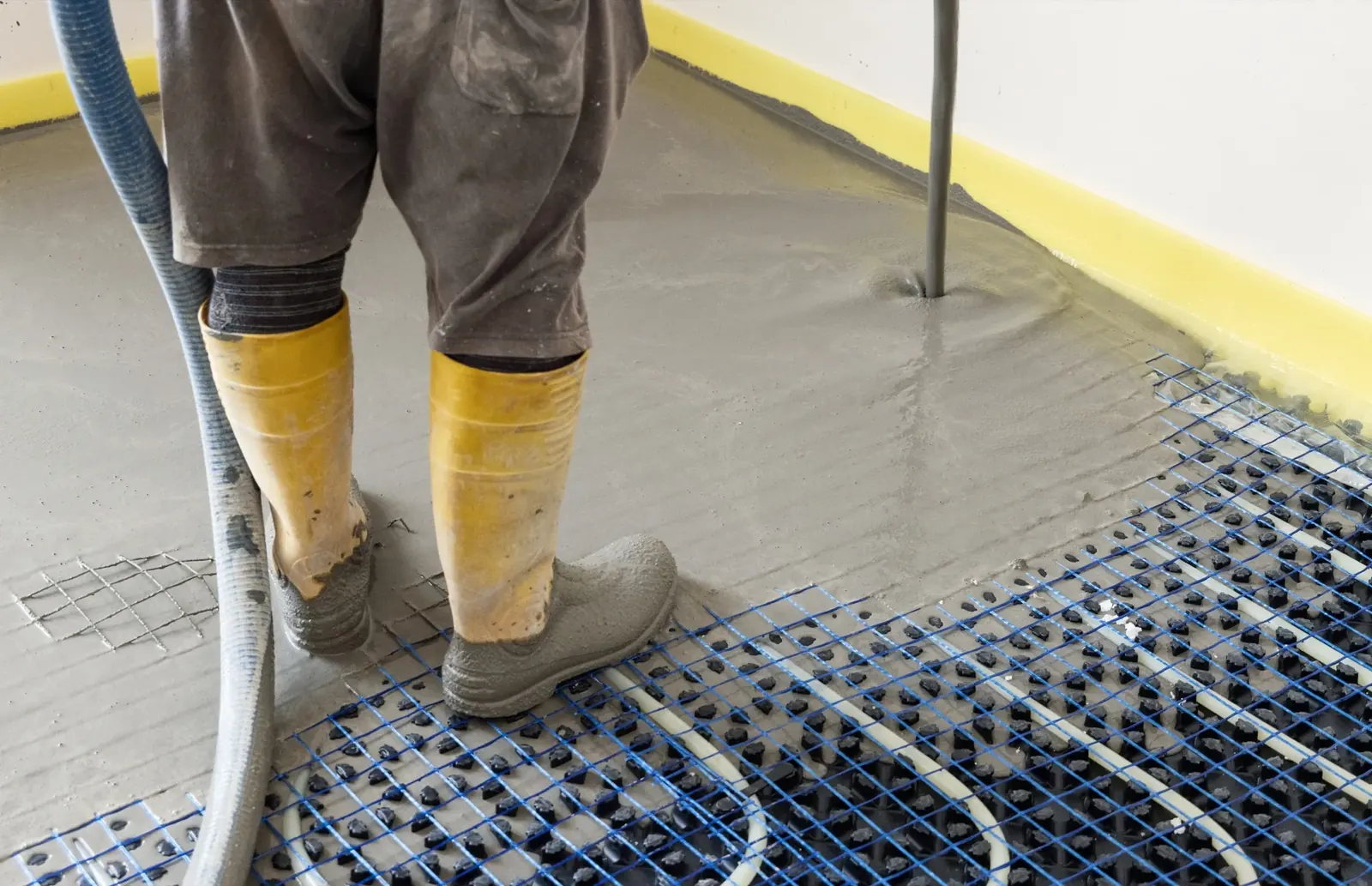
For levelling floors before the finish goes down. EN 13813 classifies them by binder (CT cement, CA calcium sulphate, MA magnesite, AS mastic asphalt, SR synthetic resin) and by compressive (C) and flexural (F) strength: a CT-C20-F4 is a cement screed with 20 N/mm² in compression and 4 in flexure. In the UK, the BS 8204 codes of practice cover how they are laid. These are the screeds used over underfloor heating; we cover them in our guide to screed for underfloor heating.
Tile adhesives
EN 12004 classifies cement-based adhesives as C1 (normal) and C2 (improved), with extra letters: F for fast-setting, T for reduced slip, E for extended open time, and S1 or S2 if they are deformable. Large-format porcelain, exterior work and underfloor heating generally call for C2, often deformable.
Repair
EN 1504-3 classifies concrete repair mortars as R1 and R2 (non-structural) and R3 and R4 (structural). They are used, for example, to rebuild the cover after rebar corrosion.
Specialist and decorative
Self-levelling compounds, anchoring and grouting mortars, waterproofing mortars and thin decorative micro-mortars, known as microcement, for seamless floor and wall finishes.
What M4, CT-C20-F4 or C2TE mean
| Code | Type of mortar | What it tells you |
|---|---|---|
| M4 | Masonry (EN 998-2) | Compressive strength of at least 4 N/mm² |
| NHL 3.5 | Hydraulic lime (EN 459-1) | Natural hydraulic lime, strength class 3.5 N/mm² |
| GP CS III W1 | Render (EN 998-1) | General purpose, compressive strength category CS III, water absorption W1 |
| CT-C20-F4 | Screed (EN 13813) | Cement, 20 N/mm² in compression and 4 in flexure |
| C2TE S1 | Adhesive (EN 12004) | Improved, reduced slip, extended open time, deformable |
| R4 | Repair (EN 1504-3) | Structural, the most demanding class |
How to choose the right mortar
- In masonry, the mortar should not be stronger than the units it joins. If it is much stiffer, cracks run through the bricks instead of the joints. Use the weakest mortar that is durable enough for the exposure.
- In old walls, lime. A cement mortar on lime-built masonry traps moisture and ends up coming away or damaging the wall.
- More cement is not better. On site, mortar is batched by volume (1:3, 1:4, 1:6 cement to sand): rich mixes are stronger, but stiffer, and they shrink more.
- Just enough water. As with concrete, extra water lowers strength and increases shrinkage.
- If it is factory-made, read the bag: the standard, the class and the intended use are all there.
Mortars with graphene
At SmartMaterials, graphene goes into two very different types of mortar:
- SmartCOVER, a 2–3 mm decorative micro-mortar (microcement) reinforced with graphene for seamless floors, walls, pools and facades. It comes in three systems (CLASSIC, ECO and the two-component HARD) and 44 colours.
- FloorGraphene, a liquid additive for underfloor heating screed that raises its thermal conductivity from 0.88 to 1.5–2.0 W/m·K depending on the aggregate.